
Positioning, Not Luck: How Stock Search Turns Metadata Into Clicks and Clicks Into Sales
Stock agencies rank by behaviour, not by keywords alone. A breakdown of the chain from keyword to position to click to sale, with the formulas, the agency documentation, and numbers from 635 photos.

Key takeaways
- Agencies rank your file by what buyers do with it, not by how many files you upload. A click or a licence moves it up; a result nobody clicks moves it down.
- Frames in a series that share the same title and keywords compete with each other for the same two or three searches. Share the topic, not the list.
- Precision beats coverage. One frame aimed at one specific buyer gets the click; a wide spray of keywords brings views nobody clicks, and that costs position.
The stock market is saturated with the same subjects, and most of our clients' portfolios still sell. Both things are true at once, and the reason is the one thing most contributors never look at: where a file sits in search, and what happens to it after the first buyer scrolls past it.
This is a long breakdown. It walks the whole chain, keyword to position to click to sale, and names what each agency documents, what is patented, what is measured and what is folklore. If you only want the rules, jump to the checklist at the end.
What every agency search has in common
Every major agency runs search in two stages. First, text selects the candidates: your keywords, your title, and at Getty and iStock the controlled-vocabulary term your keyword was mapped to. A file that does not match the query does not exist for that query. Second, behaviour orders the candidates: downloads, clicks, zooms, the age of the file, and increasingly a model's guess of how marketable the picture looks. That second stage is where sales are decided, and it is the stage contributors cannot see.
The principle is the same everywhere. The implementation is not, and the differences matter when you plan a batch. This is what each agency has actually put in writing, in a patent, or in a buyer-facing API, as of October 2026.
| Agency | What is documented | Where behaviour is scored | Source type |
|---|---|---|---|
| Shutterstock | Default sort is popularity; relevance sort "takes into account the age of the media and the popularity". Help pages name downloads and file age as inputs and say positions move continuously through A/B tests. | Patents describe a customer behaviour score for each keyword on each image, built from purchases, clicks, lightbox adds and hover previews, plus activity on images from the same artist or photo shoot. New files get a predicted marketability score from the pixels. | API docs and help (official); patents US 10,409,822, US 11,360,927, US 11,216,506 (method, not confirmed in production) |
| Adobe Stock | The first 10 keywords carry the most weight; titles are searchable and become the page URL; the newest and most-licensed content is the most visible; content that is shown but not licensed is treated as low-performing and loses visibility over time; similar files should be submitted a week or two apart so they do not compete with each other. | Per file. The trigger Adobe names is the licence, not the click. Contributors cannot see views. | Contributor help and the 2023 Mastering Metadata guide (official) |
| Getty / iStock | Keywords are mapped to a controlled vocabulary; an unmapped keyword is not used; synonyms, translations and broader terms are added by the system. Default sort is Best match. No ranking weights are published. | Not documented. Full-time contributors describe the same mechanism as the other agencies: a file shown for a query nobody clicks gets pushed back. | Contributor guidance (official) and practitioner accounts |
| Alamy | Results are ordered by a combined score of relevancy and AlamyRank. A view that is ignored lowers the rank slightly, a click raises it more, a purchase more still. Irrelevant tags "can harm your ranking in the future". Ten supertags get extra priority. Keyword order does not matter. | Per pseudonym, not per image. Alamy is the only agency that shows contributors views, zooms and CTR per search term. | Launch description 2006, contributor help and blog, July 2024 webinar (official) |
| Pond5 | "Relevant keywords play the most important role in our search algorithm"; spam "will only hurt your visibility". | Not documented. | Contributor FAQ (official) |
Two things stand out. Nobody publishes a formula, and nobody runs a single "quality score" you could read off a dashboard. What exists is a ratio of engagement to exposure, computed at different levels: per keyword and image at Shutterstock, per file at Adobe, per pseudonym at Alamy. When this post says "score", it means that ratio, wherever the agency keeps it.
The chain, written as one formula
Take one file and one agency over one year. Its expected sales are a sum over every query buyers type:
E[sales] = Σ over queries q:
           V(q) · P(candidate | q) · P(seen | rank) · P(click | seen) · P(licence | click)
- V(q) is how many buyers run that query. You do not control it; you choose which queries you enter.
- P(candidate | q) is 0 or 1. Your keywords, title and vocabulary mapping decide it. This is the only factor metadata controls completely.
- P(seen | rank) is how likely a buyer scrolls far enough to see the thumbnail. Position decides it, and position is the output of the agency's ranking.
- P(click | seen) is the click-through rate. The thumbnail decides most of it, together with how well the picture matches what the query meant.
- P(licence | click) is the conversion. Content decides it: usability in a layout, authenticity, orientation, copy space.
Metadata sits at the front of the chain and touches every later factor only indirectly, through the first two. That is why the same keyword list can be worth a lot on one file and nothing on another: the later factors multiply, and a zero anywhere zeroes the product.
The second thing the formula shows is where the sum comes from. Queries are short. In the clickstream estimate of Shutterstock's hundred most-used queries, 80% have one or two words, and in Robert Kneschke's counts about 80% of buyer queries have three words or fewer. A single query therefore tests two or three of your 30 to 50 keywords. The sum is dominated by the handful of keywords that match real queries at a position a buyer reaches. Kneschke's data on his own Shutterstock portfolio put the number of keywords that actually convert per image at three to six.
Step 1: candidacy and the launch position
A new file has no behaviour. For its first weeks, the ranking has only three things to work with: how well the text matches, how new the file is, and, at Shutterstock, what the pixels predict. This is the only period in which metadata moves position by itself, and it is short.
What the text can do at launch differs by agency:
- Adobe Stock weights the first 10 keywords most and reads the title. A word that is in the title and in the first 10 gets an extra bump. Reordering is cheap and shows up in search within hours; one contributor measured a file moving from off page one to mid page one about four hours after a reorder.
- Alamy reads the caption as a sentence and gives 10 supertags extra priority. In one contributor test on a rare plant name, a file ranked 288th with the term only in tags, 193rd with the term as a supertag, and 69th with it in both caption and supertag. Order inside the list does not matter.
- Getty and iStock map every keyword to a vocabulary node. A keyword you did not disambiguate is dropped. Order does not matter any more; it did years ago.
- Shutterstock publishes no order rule, and an analysis of its 10,472 most popular images found no sign that order helps.
The launch position then depends on one number you do control: how many other files match the same query. Under a neutral ranking, a new file is seen roughly when the buyer's scroll depth D reaches its position among N matching files:
P(seen at launch | q) ≈ min(1, D / N_q)
Buyers look at a few hundred to about two thousand thumbnails per task (the next section has the sources). With D = 2,000, a query like "background", which returns 222 million files on Shutterstock, gives a new file a visibility chance of about 0.00001. A query that returns 793 files gives it 1. This is the mechanism behind what we called keyword weight in an earlier post: a word's value to a file is close to the logarithm of how rare it is in the library, because rarity is what decides whether the file is ever reached.
weight(k) = ln( all files ÷ files that carry k )
Two consequences for a batch. First, the head terms are not where a new file is seen, whatever you do with them. Second, the "category" you place a file in is not the category dropdown on the upload form, whose weight no agency documents. It is the set of queries the file can realistically be reached for. Positioning means choosing that set on purpose, once per batch, and then giving each frame its own angle inside it.
Step 2: position decides who gets seen
No agency publishes a click curve for its own grid, so the shape has to come from systems that do. In Google organic search the first result takes about 27.6% of clicks, roughly ten times the tenth. On Amazon the first product takes 35%, the second 17%, the third 12%, the tenth 3.5%. Eye-tracking in lab studies shows a trust bias: users click the first result even when the second is more relevant, and when researchers secretly reversed the order, the average clicked rank only moved from 2.7 to 4.0.
Image grids are gentler than lists, not flat. In a log study of 100,000 image-search sessions, attention decayed more slowly across grid positions than across web results, with a measured decay of 1.06 per step against 1.48, and with a bias towards the middle of each row. The same research found that 62% of image-search sessions end with no click at all, and that users hover about twenty times more often than they click. A stock buyer scanning a grid is comparing, not choosing.
How deep they go is the number that matters for the formula above, and the few data points agree:
| Source | Depth |
|---|---|
| Alamy CEO, 2006 | buyers look at about 2,000 images per purchase |
| Alamy Measures, business searches, 2017 | 546 views per successful searcher on average |
| Jim Pickerell's reading of the same data | most buyers stop within about 500 thumbnails |
| Shutterstock API | results are capped at 2,000 per query |
| Adobe Stock engineering, 2019 | customers "don't often scroll too deep" |
So P(seen | rank) is close to 1 in the first few rows, falls through the first pages, and is close to 0 past the first one or two thousand results. For a head term that is a wall; for a niche term the wall is further away than the number of matching files, and every candidate is seen.
Step 3: a click is a vote, and a skipped impression is a vote too
This is the step most contributors have never seen stated, so here it is, agency by agency.
Alamy said it at launch, in 2006: images that are viewed but ignored lower the rank slightly, images that are clicked raise it by more, and a purchase raises it most. That rank is kept per pseudonym, over roughly the last nine to ten months of buyer activity, and the contributor help still says irrelevant tags can harm your ranking. Adobe says it in its 2023 metadata guide: a file that keeps appearing in results and is not licensed is treated as low-performing and loses visibility over time. Shutterstock does not say it in its help pages, but its patents describe a behaviour score for each keyword on each image, and a learned ranker that uses files shown without engagement as negative examples. Getty and iStock publish nothing, and two full-time contributors describe the same thing from experience: a file shown for a query nobody clicks is pushed back for that query.
Alamy is the only agency where you can watch this happen, because it shows views, zooms and the ratio between them. Its definition is simple:
CTR = zooms ÷ views × 100
The library-wide average has sat around 0.5 to 0.6 for a decade. Four or five zooms correspond to one sale, and about a quarter of sales happen with no zoom at all. One worked row from Alamy Measures: the term "business" produced 49,368 views, 140 zooms and 4 sales across the whole library, a CTR of 0.28. The term is huge, and almost nobody who typed it clicked anything.
Now the arithmetic that makes a wrong keyword expensive. A file's CTR is the sum of its clicks over the sum of its impressions across every keyword it carries:
CTR_file = ( Σ clicks_k ) ÷ ( Σ impressions_k )
Add one keyword that is popular but not what the picture shows. It brings impressions i_x and, because the thumbnail does not match the query, no clicks:
CTR_new = CTR_file × I ÷ ( I + i_x )
where I is the impressions the file had before. A file with 1,000 impressions and 6 zooms sits at 0.6. One broad keyword that adds 2,000 unclicked impressions takes it to 0.2 without changing a single pixel. At Alamy that number feeds the rank of every other file under the same pseudonym. At Shutterstock, by the patent, the damage stays on that keyword, which is why a broad keyword there costs less than at Alamy. At Adobe the trigger is the licence, so the file has to be shown and passed over before anything happens.
Agencies do not score raw CTR. Etsy, the one marketplace that documents its method in full, adjusts engagement for where the listing was shown, and Google Ads compares a keyword's click rate with other advertisers' at the same position over the last 90 days. The stock agencies that describe their ranking at all describe the same shape:
score_{t+1} = score_t + α · ( clicks − expected_clicks(rank) )
A click from row 40 is worth more than a click from row 1, because fewer were expected there. An unclicked impression in row 1 costs more than one in row 40, for the same reason. That is the whole argument for narrow positioning: you want your impressions to come from queries where the thumbnail is the obvious answer, not from queries where it is one of ten million.
Step 4: the loop closes
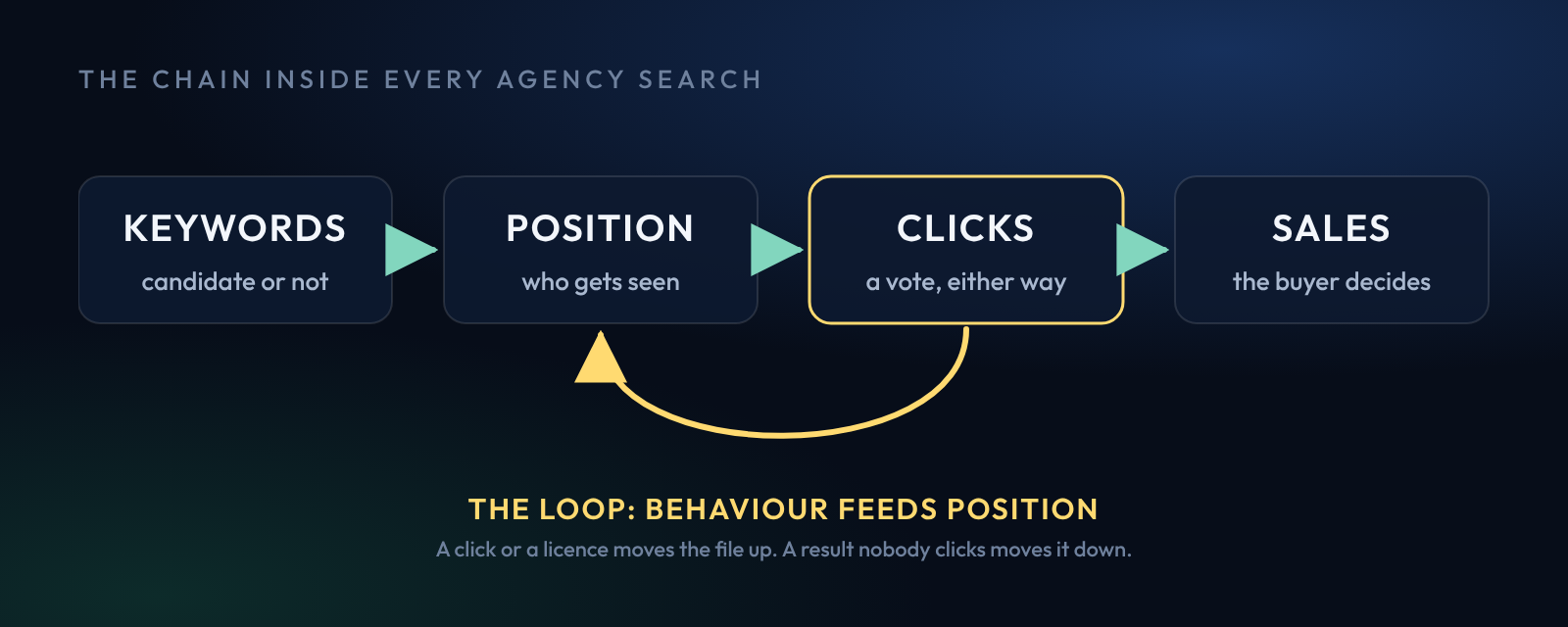
Behaviour feeds position. A click or a licence moves the file up; a result nobody clicks moves it down.
Once behaviour feeds position and position feeds behaviour, the system has a loop, and loops concentrate. Shutterstock's own patent filing says that ranking by popularity "discriminate[s] against new images" and discourages contributors. Adobe's engineering team wrote in 2019 that the top of its results showed "little variance" from one day to the next, which is why it added a model to counter position bias. The cleanest measurement of what such a loop does to a market is still the MusicLab experiment: 14,000 participants, 48 unknown songs, eight parallel worlds. In every world where people could see what others had chosen, the winners won by more, and which song won became partly unpredictable. A song ranked 26th on quality finished first in one world and 40th in another.
Agencies know this and keep channels open for files with no history: Adobe's Undiscovered and Fresh sorts, Shutterstock's undiscovered-content filter for files under about 90 days old and its pixel-based marketability score, Alamy's diversity shuffle. These channels are why an old file sometimes sells with nothing changed. They are also only useful to a file that is correctly described the first time it is shown.
The loop is slow, and slower than most advice assumes. Alamy told contributors in 2015 that rank was recomputed about every 100 days over 300 days of data, and that a new pseudonym starts at the median. Adobe says "over time" and gives no number. Shutterstock's patents mention daily retraining and 30-day windows, as examples. On the sales side, a contributor who uploaded about 800 accepted files in January 2026 reported that the first sales from them came almost two months later and that they had earned 55 dollars after three months. The popular "30 days on Adobe, 90 on Shutterstock" is folklore built from patent examples; no agency has published a launch window.
For planning, the lag means three things. Metadata has to be finished before submission, not patched afterwards, because the first impressions are the ones with no history to dilute. A file that misses its launch rarely recovers by re-keywording alone; the documented recoveries are a reorder on Adobe that moved a file within hours, and an Alamy pseudonym whose CTR took about a year to catch up. And a bad first batch under one Alamy pseudonym drags the next batch with it, because the rank is shared.
Why we position a batch, not a photo
A buyer does not buy the photo that ranked. They click one thumbnail, land on a page with a strip of similar images and more from the same contributor, and pick the frame that fits the layout. Orientation, copy space, which way the person looks, how much table is visible: the decision between frames is theirs, and it is made after search. Our job is to get the buyer onto the batch at all.
The agencies help with this more than they say. Shutterstock's behaviour patent aggregates activity across images from the same artist or photo shoot, so a click on one frame credits its siblings. Adobe tells contributors to submit similar files a week or two apart so they do not compete against each other, which is the same mechanism seen from the other side. And it shows up in the field: the contributor with the 800 new cocktail files in 2026 reported that photos he had not sold in years started selling again after the new batch went live, and a 40% rise in his overall income, which he was careful to call a coincidence he could not rule out.
The trap is to read "batch" as "same metadata". Adobe names identical titles and keywords on similar files as a signal of similar content, and a series that shares one list is a series competing with itself for the same two or three queries. We measured what a real series contains. One balcony morning routine, 39 frames, one folder: 79 different true keywords, an average of 25.5 per frame, and only 8 that are true for every frame. A wine tasting of 188 frames: 197 different keywords, 24.9 per frame. The coverage of a batch, the number of distinct queries it can be a candidate for, is the size of the union of its keyword sets:
coverage(batch) = | K_1 ∪ K_2 ∪ … ∪ K_n |
With copy-pasted metadata that union collapses to one list, about 25 words. With a buyer angle per frame the balcony series covers 79, more than three times as many entry points for the same 39 pictures, and each frame is the obvious answer for its own few queries instead of one of 39 identical answers for the same ones. That is what we mean by positioning: one topic per batch, chosen for a search neighbourhood the batch can actually be reached in, and one angle per frame inside it. The batch gets the buyer; the frame gets the click; the buyer makes the sale.
What our clients' numbers say
The background is a market that has grown by an order of magnitude while demand has not. Shutterstock reported about 70 million images in 2015 and 888 million files in early 2024; its paid downloads fell from 47.7 million in the last quarter of 2019 to 35 million in the first quarter of 2024. Getty held 625 million images and 39 million videos in mid-2026, with paid downloads down 2.8% year on year. Independent counts put the AI-generated share of Adobe Stock near half. One long-time contributor who publishes his numbers sold 48% fewer files in 2026 than in 2019 with a portfolio that had grown past 45,000. Same subjects, more files, flat demand: that is what saturation looks like in the numbers.
Against that background, we track uploads, downloads and sales for the contributors whose batches we process. Through the AI wave of 2024 to 2026, most of those portfolios did not lose sales. They also did not grow in proportion to the files added, which is the honest second half of the sentence: more files no longer buys more income by itself. The clearest single picture is one iStock and Getty account we have keyworded for years. On its ESP dashboard, monthly downloads climbed through the first part of the window, then settled on a plateau with one shallow dip and a recovery, and revenue by product type followed the same line through 2025 and 2026. It is one account, so we do not quote its totals; what matters is that the other accounts we track show the same shape, not a decline.
Holding sales flat while the market around you declines takes two things, and we see both in every portfolio that does it. The first is the quality of what gets uploaded, in the stock sense of the word: a subject a buyer needs, shot so it can be used. The second is positioning, the batch placed in a search neighbourhood where it is reached, each frame given its own reason to be clicked. Metadata is the second factor. It cannot replace the first.
Factor one: the content you upload
The strongest evidence that content decides sales comes from inside single portfolios, where the keywording habit is constant and only the subject changes. Steve Heap's 15,000-file portfolio, one keyworder, one routine: his transportation category returned about 2.2 times as much per unit of portfolio as his nature category on Shutterstock, and the share of files that never earned a dollar ranged from under 1% to almost 13% depending on the category. Keywords cannot explain a six-fold difference under the same keyworder. Sales are also concentrated: Yuri Arcurs puts 10% of his portfolio at 90% of sales, and Heap's 200 best of 14,000 files made half his photo income in 2019. The winners in every published case are a concept, a place, an access or a moment, not a technique and not a keyword list.
Buyers describe the same thing from their side. A Shutterstock subscriber who walked through his purchases for a tour business chose on whether the frame showed the specific event, the recognisable angle, the landscape orientation his thumbnails needed, and whether a hotel scene looked real or staged. He passed on a monument because he could shoot it himself and on a police car because it carried no agency marking. He never mentioned keywords. Getty reported that nearly 70% of its 2024 revenue came from exclusive content, which is a statement about differentiation, not about tags.
For the chain above, content sets two factors that metadata cannot touch: P(click | seen), because the thumbnail is the picture, and P(licence | click), because the layout decides. A batch of generic frames with perfect positioning gets seen and skipped, and the skip is recorded.
Factor two: positioning, agency by agency
The principle is one; the rules you have to follow are not. This is the table we work from.
| Agency | Keywords | Order | Title / caption | What hurts |
|---|---|---|---|---|
| Adobe Stock | up to 49, 15 to 35 recommended | first 10 carry the most weight; title words repeated in the first 10 add a bump | searchable, becomes the URL, about 70 characters | inaccurate keywords; identical metadata across similar files; similar files submitted on the same day |
| Shutterstock | 7 to 50 | no published rule; no measurable effect in the 10,472-image analysis | title of at least 5 words, who / what / where / why | repeated or irrelevant terms are audited and can cost the account |
| Getty / iStock | mapped to a controlled vocabulary | does not matter | description holds off-vocabulary terms | a keyword left undisambiguated is dropped silently |
| Alamy | up to 50 tags, 10 supertags; about 20 is enough | does not matter | caption is a searchable sentence; no stemming, so singular and plural are different terms | irrelevant tags lower CTR and the rank of the whole pseudonym |
| Pond5 | 40 to 50 | no published rule | detailed description | spam "will only hurt your visibility" |
Precision beats coverage. Every keyword is a bet that a buyer typing it will click this thumbnail.
Three rules fall out of it. The first is the one above, and the agencies with a documented mechanism settle that bet. Metadata is finished before submission, because the launch impressions are the ones that set the score. And a series shares a topic, not a list: the frames differ in their first ten words, their caption and their supertags, so that each one is the clean answer to its own query instead of a duplicate answer to a shared one.
Checklist
- Decide the batch's search neighbourhood before you keyword: which queries, with how many matching files, could a new file actually be reached for? Head terms are not it.
- Give every frame its own angle: a different first ten on Adobe, a different caption and supertags on Alamy, a different title everywhere. Share the topic, not the list.
- Finish metadata before submission. The first impressions are scored with no history to soften them.
- Remove every keyword that would bring an impression without a click. A true word that nobody searches is harmless; a popular word the picture does not deliver on is a cost.
- On Alamy, keep experiments, editorial and generic material under a separate pseudonym. The rank is shared, and it is slow to recover.
- On Adobe, space similar frames a week or two apart. On Shutterstock, never delete and re-upload a file that has history; the history does not carry over.
- Measure what the chain measures: rank for five target queries on day 1, 30 and 90; time to first sale per file; the share of files with at least one sale after 90, 180 and 365 days, per batch; on Alamy, CTR per pseudonym and the search terms with many views and zero zooms, which are the keywords that cost you.
FAQ
Does a low click-through rate really lower a stock photo's ranking?
At Alamy, yes, by the agency's own description: a view that is ignored lowers the rank slightly, and the rank is shared by every file under the same pseudonym. At Adobe the documented trigger is a file that is shown but not licensed, which is then treated as low-performing. At Shutterstock the mechanism is described in patents per keyword and image, not in the help pages. At Getty and iStock nothing is published; experienced contributors report the same behaviour.
Is there a quality score I can see?
No. No agency shows a single score. Alamy shows views, zooms and CTR, which is the closest thing to a window on the mechanism. Adobe's dashboard ranks you by sales, which is not the search rank. Everything else has to be inferred from where your files appear.
How long does it take for a new file to find its position?
Longer than most advice claims. Alamy once recomputed rank about every 100 days over 300 days of data. Adobe says "over time". A contributor who published his numbers saw the first sales from an 800-file batch almost two months after upload. The exact "30 days" and "90 days" figures that circulate come from examples in patents, not from published rules.
Should a series share the same keywords?
It should share a topic. Identical lists make the frames compete for the same two or three queries and, on Adobe, are named as a signal of similar content. In a real 39-frame series we counted 79 true keywords of which only 8 belonged on every frame; the other 71 are the entry points a shared list throws away.
How we counted
The series numbers come from four shoots processed in Stock ImageIQ in October 2026: a wine tasting (188 photos), a rooftop spa (199), friends gaming at home (169) and a balcony morning routine (79, of which the series above is 39), 635 photos in all. Keyword weights use the natural logarithm. The agency statements are taken from the agencies' own contributor help, blogs, API documentation and, for Shutterstock, patent filings, which describe methods and do not confirm what runs in production. Click curves and scroll depth come from published studies of web, e-commerce and image search and from Alamy's own figures; no agency publishes a click curve for its grid. The client observations are ours; the formulas are a model of the documented mechanism, not an agency's code. Nobody, including us, has published a controlled experiment that measures how much a keyword change moves sales, and this post does not claim one.
Sources: Shutterstock API, searching · Shutterstock help: what determines order in search · Shutterstock patent US 10,409,822 · Shutterstock patent US 11,360,927 · Shutterstock patent US 11,216,506 · Adobe Stock: tips for effective titles and keywords · Adobe Stock: Mastering Metadata guide, 2023 · Adobe Tech Blog: position bias in Adobe Stock search, 2019 · Alamy: captions and tags · Alamy contributor FAQ: captioning and keywording · Selling Stock: Alamy Measures, 2017 · iStock search guide · Pond5 contributor FAQ · Etsy Seller Handbook: how Etsy search works · Google Ads Help: about Quality Score · Xpiks: analysis of 10,472 top Shutterstock images · Xpiks: top 100 Shutterstock queries · Backyard Silver: keyword order on Adobe Stock · Xpiks: best-selling categories · Xpiks: unsold stock photos · Freakonomics: the stock photo episode (Arcurs) · Getty Images 10-K 2024 · Salganik, Dodds and Watts, MusicLab, 2006 · Wollertz: 1,000 stock photos, 3 months · Blokhin Films: how to keyword and title stock content · Luka Ažman: how to keyword stock photos · Nicole Glass: a Shutterstock customer explains what he buys.
Stock ImageIQ positions every batch in one search neighbourhood and gives each frame its own angle, so the batch gets the buyer and each frame gets the click. Try it on your next shoot.
Read next: Keyword Weight: Why Niche Keywords Win in Stock Search · Same keywords on every photo? Your series is competing with itself