
Your Stock Photo Needs a Value Proposition. Test It Like a Startup Tests Landing Pages
A startup that doesn't know its ideal customer tests several landing pages. Do the same with a stock series: buyer angles spread it across more searches.
A stock photo has a value proposition, just like a product: the reason one particular buyer picks it over a million others. Most contributors give a whole series a single proposition, usually the most obvious one, and every frame then competes for the same crowded search. A young company that doesn't yet know its ideal customer does the opposite. It tests several landing pages, each with a different promise to a different customer, and lets the results decide. Your series can work the same way: give similar frames different buyer angles, so the series shows up in more searches.
What positioning means
Positioning is deciding who something is for, what it will be compared with, and why that buyer should choose it. Companies that do it well don't start from a slogan. They start from evidence: which customers already buy, which messages already work, and why. Then they test the message in the market and keep refining it until it sticks.
A photo works the same way. A generic description of what's in the frame is not a position. "Two people at a desk" tells a buyer what they'll see, not why it's the right picture for their page.
A new company tests before it knows
Early on, most founders don't know their ideal customer profile yet. They have guesses. So instead of betting everything on one message, they build two, three or five landing pages. One speaks to small agencies, one to in-house teams, one to freelancers. Each page makes a different promise. Traffic and sign-ups then show which promise lands with which customer, and the company doubles down on that.
None of those pages is wrong. They're hypotheses. The mistake would be to write one vague page for everyone and wait.
Every new batch is a new company looking for market fit
Every batch you upload is a small new company of its own. It has no sales history and no known buyers yet, and like any new company it has to find its market fit, in a market that's already crowded. So it has the same problem as the startup, and it can use the same answer.
Look at a typical shoot: 30 frames of colleagues in an office. The usual metadata gives all 30 the same proposition: "business meeting", "business people", "teamwork". That's one landing page shown to everyone.
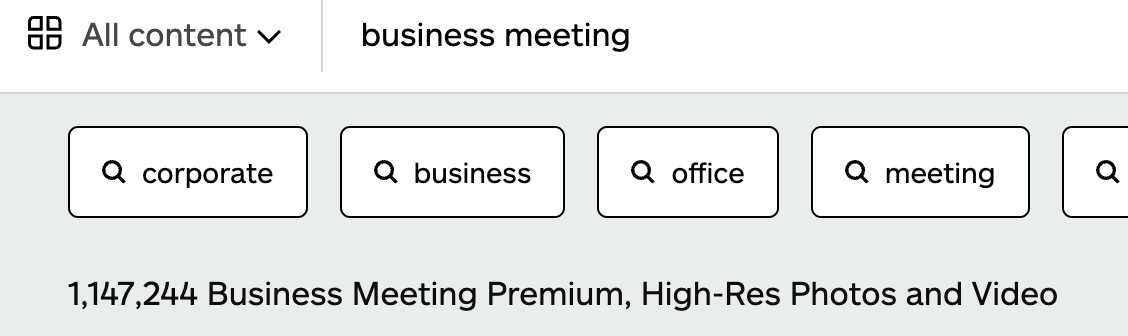
It also means all 30 frames compete for the same search, against everyone else's frames. When we searched iStock for "business meeting" on 8 November 2026, it returned 1,147,244 results across photos and video. In a search that size, whether your frame lands on the first page is mostly out of your hands. Ranking belongs to the agency.
One shoot, many buyers
A photo of businesspeople isn't only a business meeting. Look at the frames again, one by one:
- two colleagues laughing over a drink: after work;
- three people leaning in over a laptop: catching up with colleagues;
- one person handing a folder to another: a quick favour;
- someone pointing at a colleague's screen: a helping hand;
- a senior colleague explaining something to a new hire: assistance at work.
These five are only examples: possible interpretations that show how the concept works, not a fixed list of labels. A different shoot will suggest different angles, because they come from what's in the frames.
Every one of those angles is backed by something that is really in the frame: an emotion (laughter, focus, relief) or the content itself (a folder changing hands, a finger pointing at a screen). That's the rule. An angle the photo can't support is just a wrong keyword. Adding more angles like these, each one grounded in the image, is exactly what a new company does when it tests several landing pages: more honest hypotheses, more chances to find the buyer who fits.
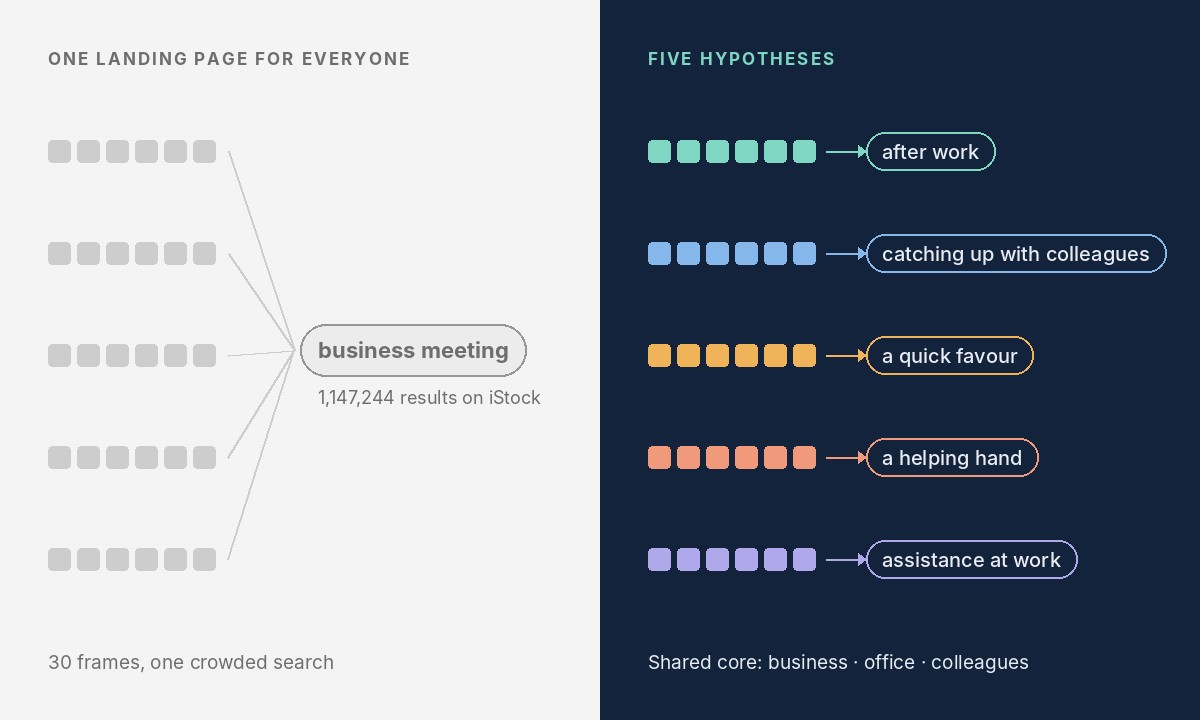
Each of those is a different value proposition, written for a different buyer: a blog about workplace friendships, an HR campaign about onboarding, an article about office etiquette, a training company. Each one lives in a smaller, more specific search, where a well-described frame has a real chance to be seen.
In the metadata, the angle shows up in the title and in the first specific keywords, the ones agencies weigh most. Change those, and the same frame is offered to a different buyer.
How we do it
Stock ImageIQ treats a series the way a founder treats landing pages. It analyses each frame, together with the context you give about the shoot, and assigns every frame its own buyer angle. Near-identical frames don't get the same title or the same first keywords, so they don't compete with each other. They spread across different searches instead of piling into one.
A buyer angle doesn't take a frame out of its topic. If the shoot is about business, every frame stays a business photo. The whole batch, whether it's 20 files or 150, keeps a shared core of three to five keywords that define the topic, and that core decides the category placement. The angle is added on top of the core: it changes the title and the first specific keywords, not what the photo is about.
Long story short: the topic is still business. We just give search more to rank each frame on, based on what's visibly in it: the concept, the emotion, and what the people in it are doing.
The analysis is ours. The facts are yours: who is in the shoot, where it was taken, what the scene is about. That's what keeps the angles honest.
Where the startup comparison ends
A landing page test has one thing a stock series doesn't: the startup knows exactly which page each customer came through. An agency doesn't tell you that. It links frames from the same shoot as part of a series and as similar photos, so a buyer who found one frame through its buyer angle may license the frame next to it. A sale shows which frame the buyer chose, not which search brought them to the series.
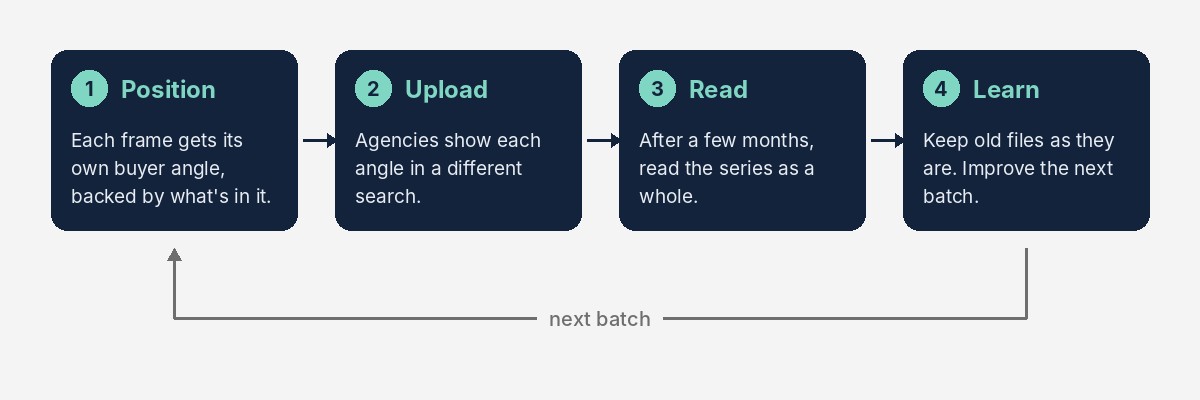
- Give it time. Search traffic on agencies builds slowly. Look after a few months, not a few days.
- Read the series, not only the file. A sale tells you the series reached a buyer. It doesn't prove which angle did the work.
- More doors into the same series. That's what different angles are for: each one is another search the series can be found in. Once a buyer is inside, the agency's series and similar-photo links show them the rest of the shoot.
- Learn forward, not backward. Don't go back and rewrite the metadata of files that are already online. Leave them be, and put what you learned into the next batch.
There's no guarantee that any angle sells. What changes is that you stop betting a whole shoot on one search.
FAQ
What is a value proposition for a stock photo?
It's the reason a specific buyer would pick that photo for a specific use. In the metadata it lives in the title and the first specific keywords, on top of the shared core that defines the topic.
Why shouldn't similar photos have the same keywords?
Because they then compete for the same search, against each other and against everyone else. Different buyer angles spread a series across different searches.
How do I know which buyer angle works?
You don't, not for a single file. Agencies show buyers other frames from the same series and similar photos, so a buyer who found the series through one angle may license a frame with a different one. A sale shows which frame was licensed, not which search led there. That isn't the point of buyer angles anyway: they spread the series across as many relevant searches as possible, so buyers can find it from more directions.
Does a buyer angle move my photo into another category?
No. On agencies that use categories, the category follows the shared core of the batch, the three to five keywords that define its topic, so a business shoot stays in business. Each frame then gets its own buyer angle on top of that core. You can edit the title and keywords before export.
Sources: iStock search for "business meeting": our own search, 8 November 2026.
Read next: Looking for an AI Keyword Generator? Why Describing Pixels Isn't Enough · How to Choose an AI Keywording Tool (and Why a Cent per Image Doesn't Add Up)